How it works

Watering from a measured number

A wireless soil sensor reads each area. A smart valve does the watering. Garzed is the intelligence between them: it measures what each area's soil actually holds, learns what's planted there, and waters each area to its own range.

One garden with several watering areas, each labeled with the soil capacity Garzed measured in August 2026
ASPARAGUS · 70
TOMATO · 60
GREENS · 54
POTATO · 48
CHARD · 42
CORN · 42

The mechanism

It measures each area's soil capacity

Calibration is a soak: Garzed waters the area, then watches the soil drain. The level the sensor settles at after drainage is that area's soil capacity — the number everything else is judged against. Sensors don't read alike out of the box and no two soils hold water the same way, which is why the range is measured per area rather than assumed.

The watering trigger comes from what's planted

Plants should dry down to a percentage of the soil's capacity, then be watered back to it — and how far each plant should dry down is different. Garzed's plant library carries those dry-down points, so an area's trigger protects its thirstiest plant. Lawn areas work the same way, by grass type. The library also charts which plants water well together on one watering system.

Watering is pulses, and it stops at capacity

When an area hits its trigger, Garzed waters in short pulses that pause to let water soak in, re-checking the sensor between pulses, and stops when the soil is back at its measured capacity.

If a sensor drops, a backup schedule covers it

Garzed builds a backup schedule from each area's own watering history. If the sensor goes offline, the backup fires until the sensor is back. The area doesn't go dry waiting.

Three modes, per area

Every area is on exactly one of these, and mixing is normal — a couple of areas on Full Auto, the rest on schedules, is a common setup.

Manual
You water. Garzed keeps reading the sensor, flags dry areas, and holds calibration.
Schedule
The familiar smart-watering setup: your timer, with rain skips — plus the live soil reading beside it, so you can see what the schedule actually does to the soil.
Full Auto
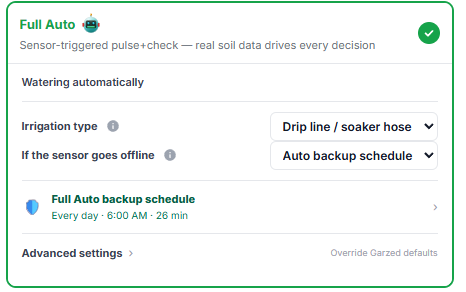
The measured system above: trigger from what's planted, pulses, stop at capacity. Needs both a soil sensor and a smart valve — the only thing that does.
Pick your level of automation
Schedule mode lets you set your own timer with rain skips — just a smart valve. Full Auto adds a moisture sensor: Garzed pulses water, checks the soil, and stops when it's right. Pick the level that fits your setup.
Watering settings showing Schedule and Full Auto modes
Full Auto watering mode expanded showing its real settings — irrigation type, backup schedule, and advanced overrides
It learns each area, then waters it right
Every plant has a dry-down point — how far the soil can fall before it needs water — and Garzed knows it for each plant in its library. An area shares one watering, so in a mixed area Garzed waters when the thirstiest plant reaches its point — nothing sensitive gets too dry — then refills the soil back up to the area's soil capacity. Deeper-rooted plants could ride a little drier, but the area looks after the ones that can't. Each area runs on its own plants.
Garzed area detail with the per-plant watering range and Full Auto controls
Watering-range chart: each plant's dry-down point, with the area watering from the thirstiest plant's trigger up to soil capacity
Weather that talks to your plants
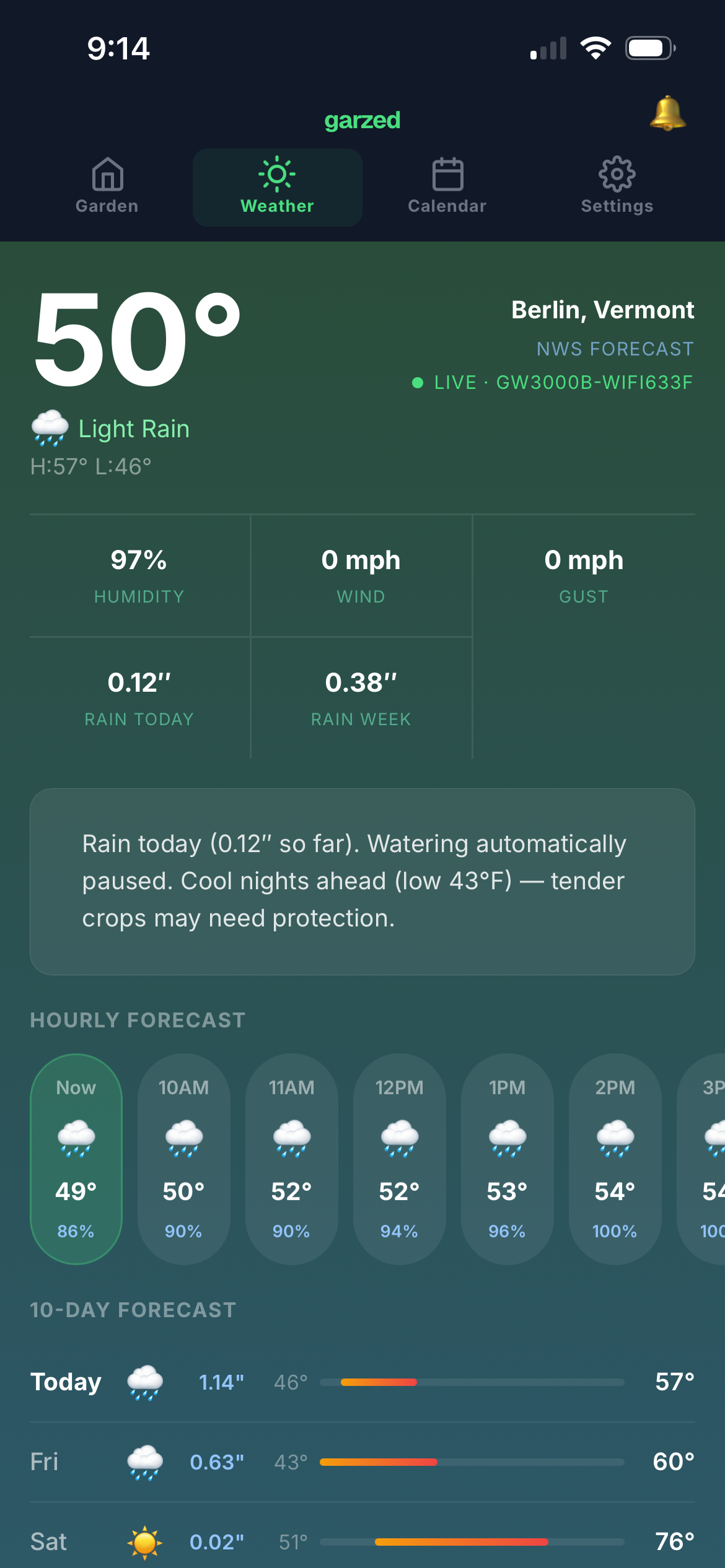
Garzed reads your local forecast to plan ahead — pausing watering when rain's coming, warning you about frost, and showing you the week ahead. Pair an Ecowitt or Tempest weather station and it switches to live, hyperlocal readings from your yard.
Weather page showing live conditions, rain-skip status, and forecast
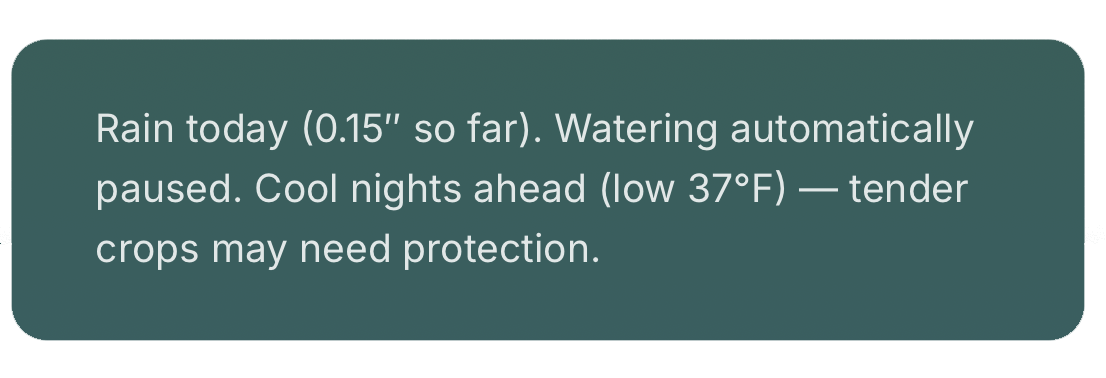
Garzed's weather advisory: rain today, watering paused, cool nights ahead
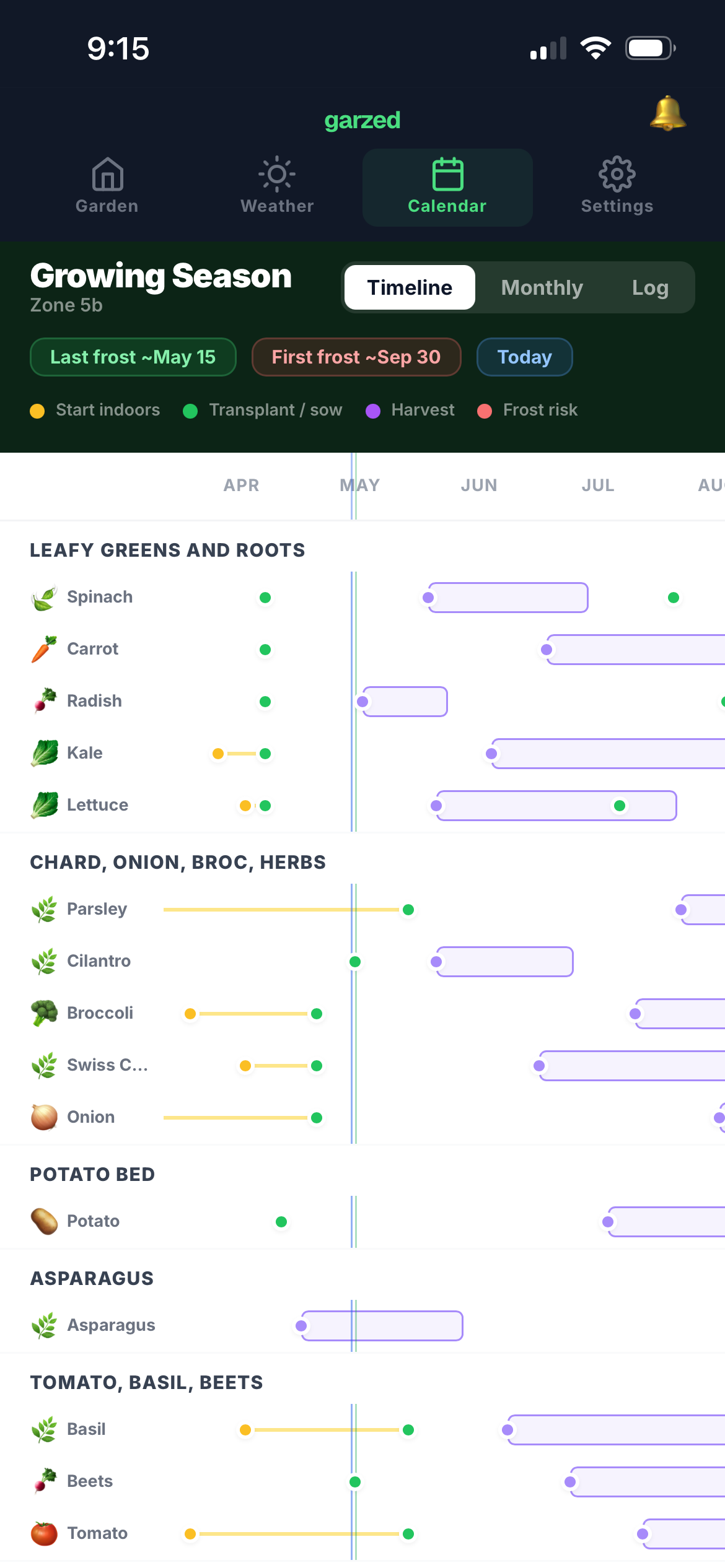
A calendar driven by your actual season
Growing Degree Units track heat accumulation to tell you when plants are ready — a measure that sees an early or late spring where fixed calendar dates cannot. Frost dates, planting windows, and harvest timing all in one view.
Season timeline with frost dates and planting schedules
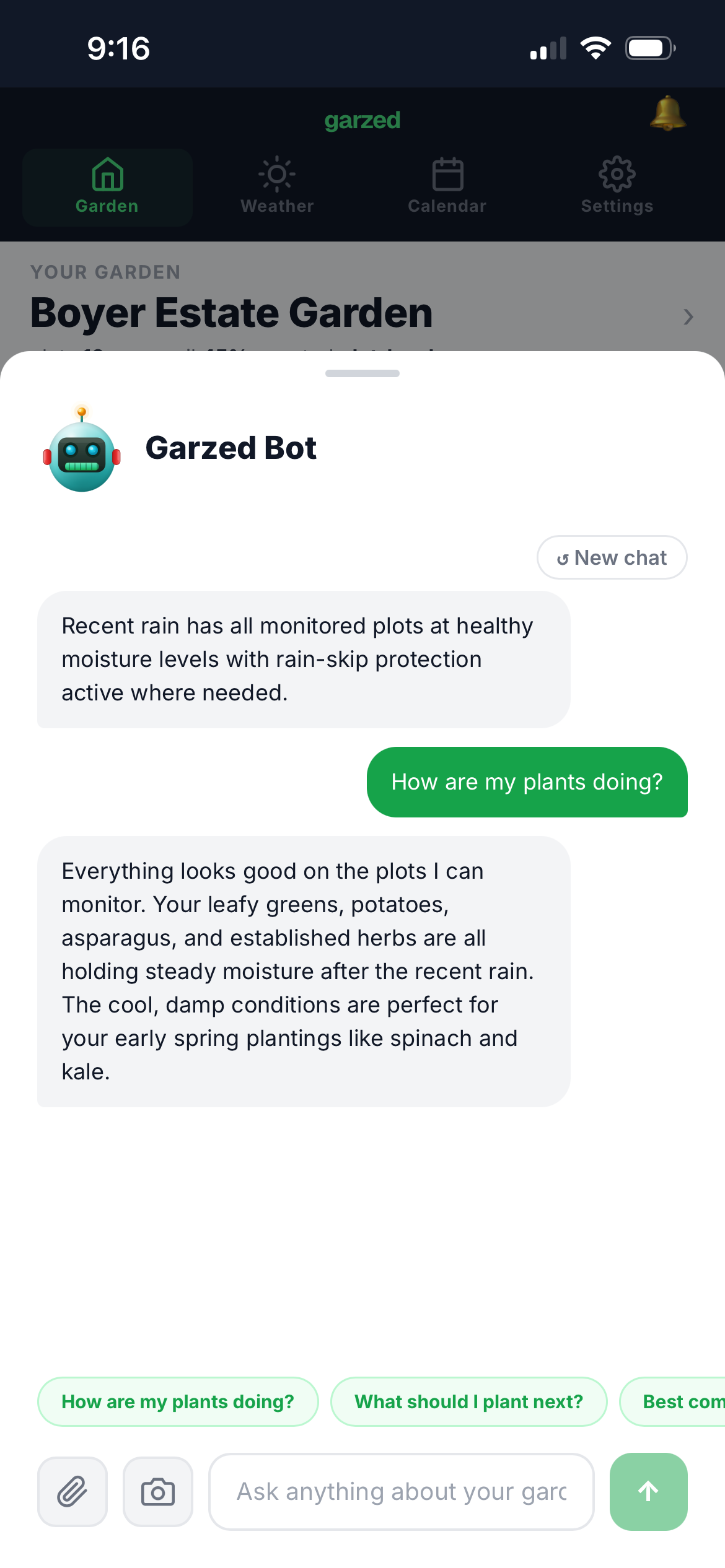
A helper that knows your plants
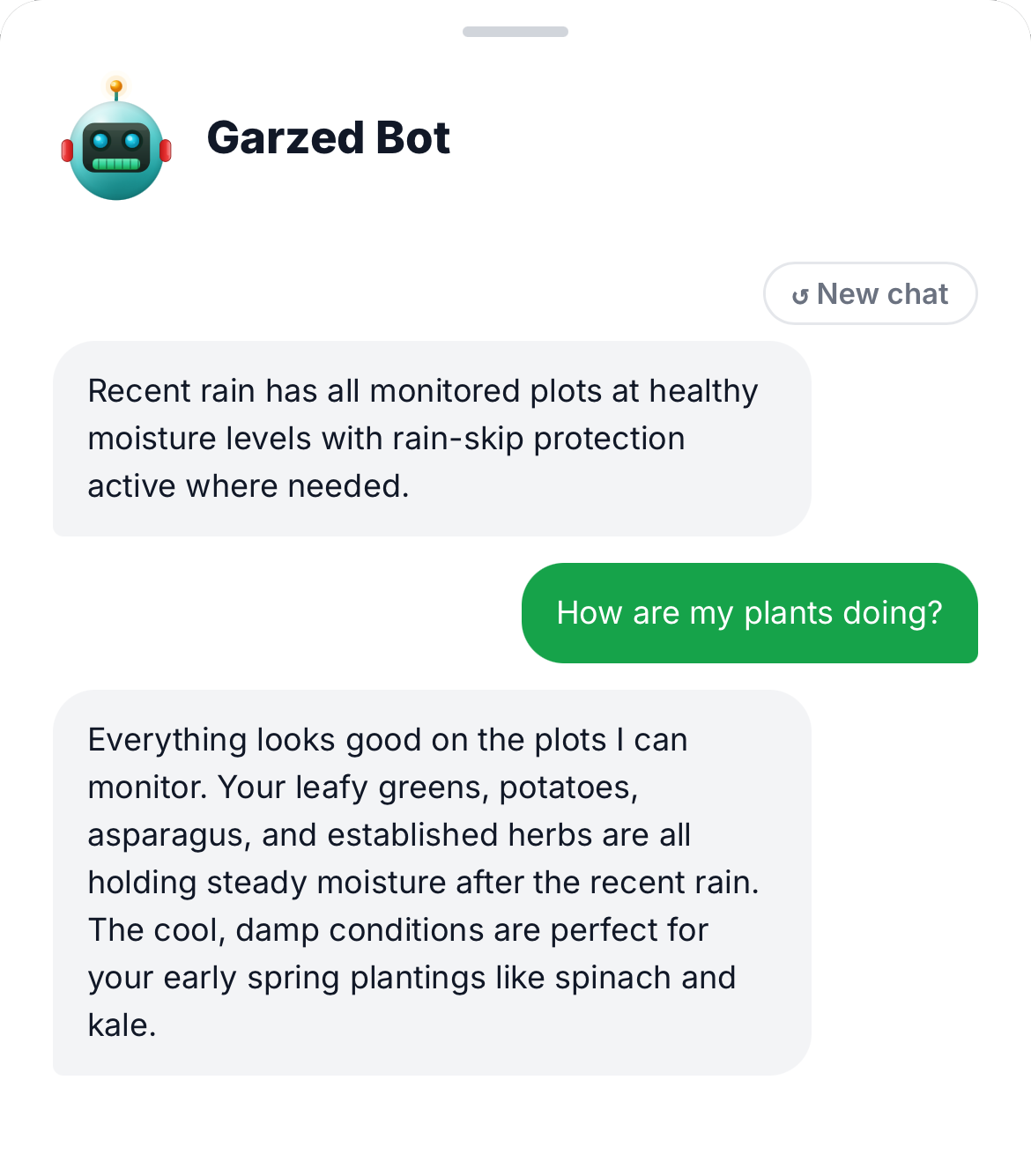
Garzed Bot gives advice that fits your actual setup — your areas, your plants, your readings. Ask why a leaf looks off, send a photo of pest damage, or get a second opinion on what to try next.
Garzed Bot chat showing context-aware plant advice
Garzed Bot answering 'How are my plants doing?' with plant-specific detail about the user's leafy greens, potatoes, asparagus, and herbs

Where Garzed fits

What you're comparing
Hose timerWaters on a clock
Smart sprinkler controllerRachio, B-hyve, Hunter
Sensor watering systemsNetro, Moen, RainPoint
Garzed+ a soil sensor
How it decides to water
The clock
Weather forecasts
Soil reading vs a level you choose
Soil reading vs a target it measured
Who sets the moisture target
You, by trial and error
Measured per area, tuned to what's planted
When watering stops
After the minutes you set
At a level you set
At the area's measured soil capacity
What you buy
The timer
The controller
Their sensor + their controller
A soil sensor kit (about $50) for the Rachio you have
Schedules, rain skip, app control
Schedules only
Sensor watering systems do water from a soil reading. The differences are who sets the target - Netro, Moen and RainPoint act on a moisture level you pick and tune, while Garzed measures each area's soil capacity and derives its target from what's planted - and that they pair their own sensor with their own controller, while Garzed works with the Rachio and Ecowitt gear you choose. Hunter Hydrawise takes wired soil sensors, with wire runs from each area back to the controller.