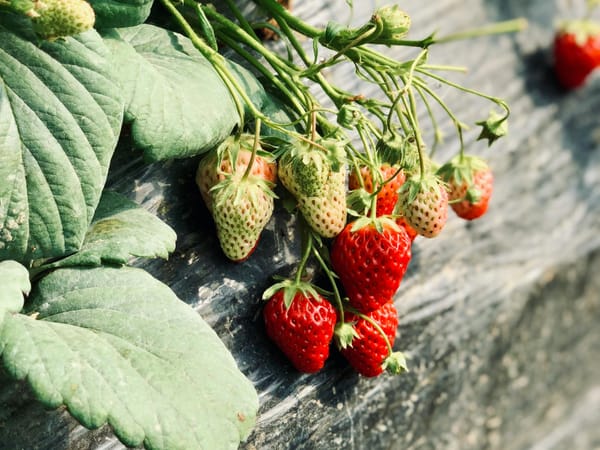
Strawberries need full sun (at least six hours, ideally ten or more hours of direct sunlight per day) and perform best with the equivalent of 1 inch of rainwater per week. Remove flower buds for the first few weeks after planting to allow the plant to establish roots and leaves before fruiting.
Harvest signs
Strawberries ripen from the tip towards the leafy stem end. Most will be completely red when ripe. Some varieties have 'white shoulders' where leaves cover the fruit. Look through the plants daily once red color is developing and harvest ripe fruit. A deep red color indicates ripeness.
▶Planting reference— Depth, spacing, light
Depth
Plant center of the crown at the soil line with the roots fully buried and growth visible above the soil. If the crowns are planted too shallow they lose water and can die. If the crowns are planted too deeply the leaves may not be able to emerge from the soil.
Tarnished Plant Bug:Feeds on developing flowers, causing deformed berries; puckering or 'cat facing' at the tip of the berry; damage concentrated at the tip; often feeds on multiple berries per cluster. (Look for adults when flower buds are green or white, before strawberry flowers bloom.)↗
Strawberry Bud Weevil (Strawberry Clipper):Clips off flower buds in spring, reducing harvest. Look for clipped buds. (Before strawberry flowers bloom.)↗
Slugs:Feed on ripe fruit, leaving small, deep holes in the fruit and irregular holes in foliage. (When strawberries are ripe. Inspect and apply baits if damage is detected.)↗
Flower Thrips:Feeding causes berries to appear bronzed and seedy.↗
Spotted Wing Drosophila:A particular problem of ever-bearing strawberries and other soft fruits. (Set out traps when strawberry flowers are in full bloom; harvest fruit as it ripens to help protect against them.)↗
Rodents and Birds:Large holes in ripe fruit. (When fruit is ripe.)↗
Common diseases · 4
Gray Mold (Botrytis cinerea):Fungus rots the fruit and produces powdery, gray spores on the surface of the fruit. Rot spreads to adjoining berries. Fruit dries down to a shriveled mummified berry. Infections may attack blossoms. Plants damaged by winter injury may develop Botrytis crown rot where leaf and flower stems rot and turn brown at the crown.↗
Leaf Blight (Phomopsis obscurans):Solid reddish-purple spots on leaves; spots develop a tan center as they grow; spots enlarge to V-shaped lesions with dry brown centers and reddish-purple borders; severe infection can turn whole leaf brown; black specks produce fungus spores; reddish-purple spots can appear on stems; mushy pink spots on fruit become dark brown and dry.↗
Leaf Scorch:Caused by a fungus; managed similarly to gray mold, leaf blight, and leaf spot. Fungi require long periods of continuous wetness to infect plants.↗
Leaf Spot:Caused by a fungus; managed similarly to gray mold, leaf blight, and leaf scorch. Leaf diseases often have little effect on plant growth.↗
Companions & antagonists
Plant near:SpinachLettuce
Keep apart from:Fennel
Tip: Perennial - returns each year. June-bearing varieties fruit the spring AFTER you plant them, not the first season.
Common questions
How much water does strawberry need?
Strawberry is water-sensitive — shallow roots and a steady thirst. Keep soil moisture in roughly the 45–65% range and don't let it dry out fully, or growth stalls and leafy crops turn bitter.
Can I grow strawberry in a raised bed or container?
Strawberry is a perennial that stays put for years, so give it a permanent in-ground spot or a large, deep container it can live in long-term.
Does strawberry come back every year?
Yes — strawberry is a perennial. Plant it once and it comes back each year, so pick a spot it can keep for several seasons.